Five ongoing thrusts at the intersection of statistical thermodynamics and soft-matter chemical physics — derivations are tedious, but the resulting expressions are often simple.
01
thrust · R-01
Hybrid Adaptive Particle-Field Simulation Method for Solvated Systems
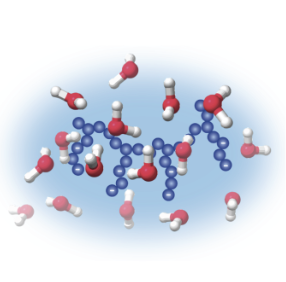
All-atom simulations are great for studying how molecules interact, but they get very expensive for large molecules in solution, like the DNA in our bodies, because of all the solvent around them.
We are developing a hybrid adaptive particle-field method that keeps full atomistic detail only near the macromolecule and treats the solvent farther away as a field. The two regions adapt to the molecule's shape on the fly, with no hard boundary between them, so we can simulate large molecules in solution much faster.
02
thrust · R-02
How Large Is Too Large? Deciphering the Rule for Molecular Size in Kidney Filtration
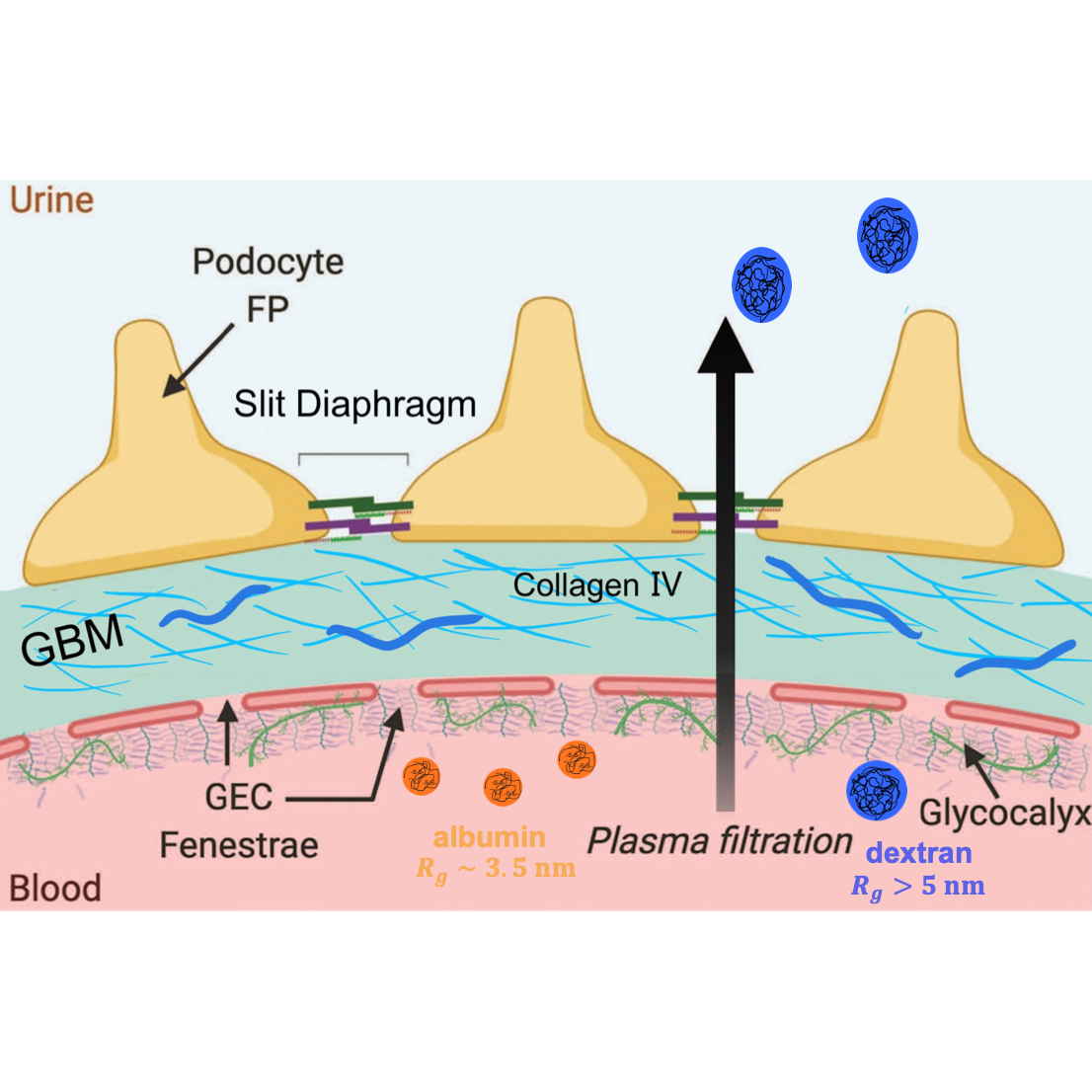
More than 10% of the world’s population is affected by kidney disease, and many cases originate from problems with the glomerulus, the filtration unit of the nephron. The kidney glomerulus filters blood into the urine, allowing water, sugar, and metabolic waste to pass through, while keeping essential proteins in blood without clogging the filter. It is not well understood why larger, flexible molecules such as dextran can pass through this filtration barrier, whereas smaller but globular proteins like albumin are mostly retained.
Several sub-projects are possible: (1) Can we quantitatively measure the effective size of macromolecules in kidney filtration? (2) Can we elucidate the physical mechanisms underlying proteinuria and chronic kidney disease? (3) How do biological forces and fluid flow influence glomerular filtration?
03
thrust · R-03
Statistical Field Theory for Polar and Polarizable Liquids
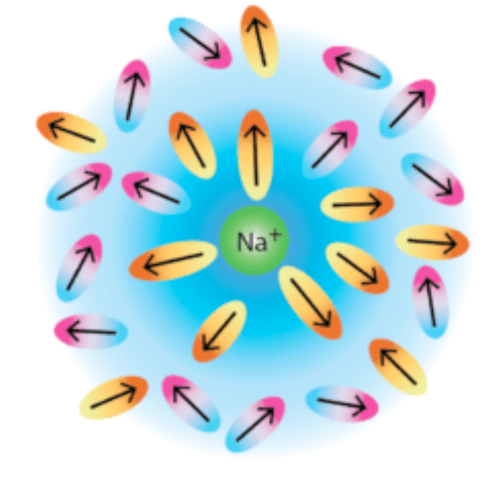
We use statistical field techniques to develop theories that can account for the complex correlations in polar and polarizable liquids. While the derivation is tedious, the resulting analytical expression is often simple.
Two key results from this thrust: a more accurate expression for the liquid dielectric constant, and a quantitative description of the like-dissolves-like principle for predicting liquid miscibility.
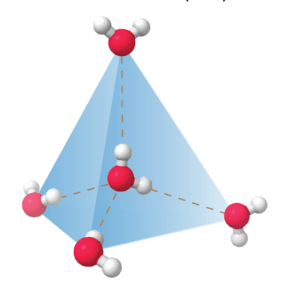
Water exhibits unusual properties compared to typical liquids — most famously a maximum density at 4 °C rather than continuous expansion upon heating. We explore whether water behaves as a mixture of distinct structural arrangements, and develop mathematical measures that identify these two phases.
Together with experimental collaborators, we have decoded a percolation-like phase transition in water near 330 K using upconverting-nanoparticle thermometry as a structural ruler.
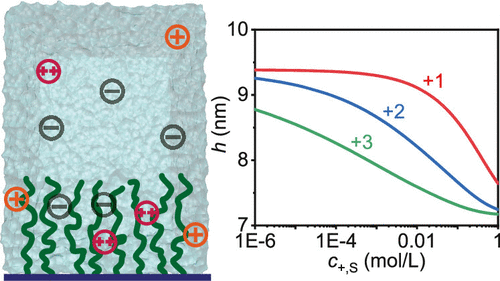
Polyelectrolyte brushes — dense layers of charged polymers grafted to a surface — change conformation dramatically with the ionic environment. We build unified theories for how solvent quality and ion valency together set brush morphology.
Recent work covers zwitterionic peptide brush sequence-structure relationships, ion-adsorption-driven nonelectrostatic attractions, and synergistic regulation by solvent quality and trivalent ions.